
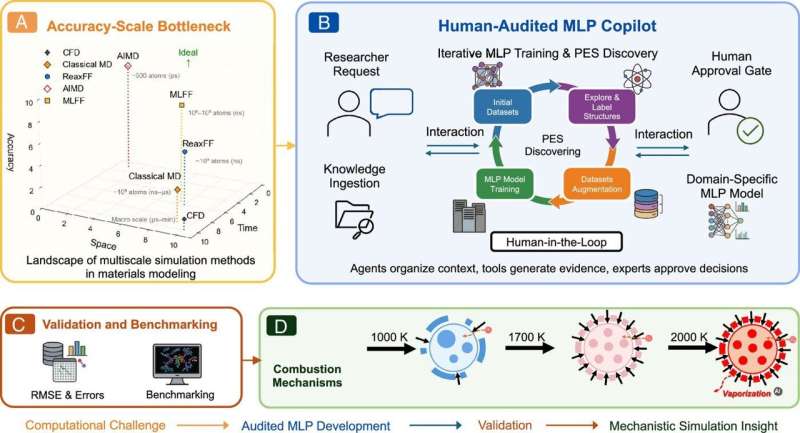
AI-assisted atomic models reveal how protective shells regulate aluminum nanoparticle oxidation
Recent research published on Phys.org demonstrates how artificial intelligence assists in constructing atomic models to understand aluminium nanoparticle behaviour.
The story
in brief.
What happened, who it affects, and why it landed on our intelligence desk — in plain English, sixty seconds or less.
Recent research published on Phys.org demonstrates how artificial intelligence assists in constructing atomic models to understand aluminium nanoparticle behaviour. The study specifically reveals how protective shells regulate the oxidation process of these particles. By leveraging AI, scientists can now visualise and analyse these microscopic interactions with greater precision than previously possible. This advancement highlights the growing intersection of computational methods and materials science, offering deeper insights into nanotechnology applications. The findings are significant for industries relying on advanced materials, as they provide a clearer understanding of degradation mechanisms at the atomic level.
Indicative index of skill mentions in professional job postings for the field this story moves (2019 = 1)
What this means
for your career.
Every headline redistributes opportunity. Here is who this one rewards — and how to be on the right side of it.
This development signals that expertise in computational modelling is becoming essential for materials engineers and scientists. If you work in manufacturing or R&D, you must now understand how AI accelerates discovery. Professionals who can bridge the gap between domain knowledge and AI tools will command higher value. You should focus on learning how to interpret AI-generated data rather than just generating it. Upskill in data literacy and computational methods immediately. Collaborate with data scientists to integrate these insights into your workflows. Ignoring this trend risks obsolescence in technical roles. Proactively seek training in AI applications within your specific engineering discipline to stay competitive.
For this story, the fields that convert it into pay are Artificial Intelligence, Engineering, Data Science and AI in Manufacturing — exactly the programmes matched below. The chart shows the indicative salary uplift certified professionals report in each of those fields; every one of them is a click away, from £79, finishing in as few as 20 days.
Indicative ranges from published continuing-education salary studies, by field — each field is a recommended course below
Enrol in these
to benefit.
These programmes position you for exactly this shift — online, self-paced, and finishing with a verifiable certificate you can share the day you pass.
 Best match
Certificate in Artificial Intelligence
 Recommended
Certificate in Engineering
 Recommended
Certificate in Data Science
 Recommended
Certificate in AI in Manufacturing
Launch pricing shown against standard certificate value. The fee you see today is the fee you lock in.
This briefing is based on reporting by Phys.org on 10 Nov, 02:00. Read the original coverage →
Read the news. Then outrun it.
Every LSBR programme is online, self-paced and from £79 — so a headline today can be your credential this month.
