
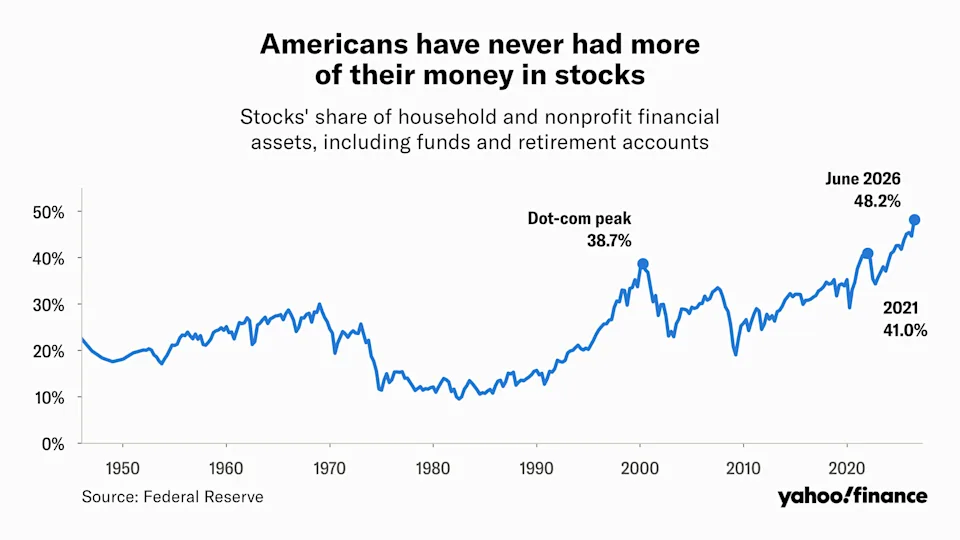
Americans have never had more of their money in stocks — not even in the dot-com bubble: Chart of the Day
Recent market data indicates that American households now hold a record-high proportion of their wealth in equities, surpassing levels observed during the dot-com bubble era.
The story
in brief.
What happened, who it affects, and why it landed on our intelligence desk — in plain English, sixty seconds or less.
Recent market data indicates that American households now hold a record-high proportion of their wealth in equities, surpassing levels observed during the dot-com bubble era. This significant shift suggests a growing confidence in stock markets among retail investors, despite historical precedents of volatility. The trend reflects a structural change in personal finance strategies, with more individuals directly participating in capital markets rather than relying solely on traditional savings or fixed-income instruments. This development highlights the increasing integration of equity investments into everyday financial planning, marking a pivotal moment in consumer investment behaviour and asset allocation patterns across the United States.
Indicative index of skill mentions in professional job postings for the field this story moves (2019 = 1)
What this means
for your career.
Every headline redistributes opportunity. Here is who this one rewards — and how to be on the right side of it.
This surge in retail equity participation demands sharper financial literacy from every professional. You must understand market dynamics to manage personal wealth and advise clients effectively. Skills in data analytics and risk assessment are now critical for interpreting volatile market signals. If you work in finance, deepen your expertise in AI-driven investment tools to stay competitive. For others, grasp basic portfolio theory to protect your savings. Smart professionals will upskill in quantitative analysis and regulatory compliance, ensuring they can navigate complex financial landscapes. Prioritise courses that blend technical data skills with strategic financial decision-making. This is not just for bankers; it is essential knowledge for anyone seeking career resilience in an increasingly financialised economy. Act now to future-proof your expertise.
For this story, the fields that convert it into pay are Finance, Data analytics, Risk Management and AI in Finance — exactly the programmes matched below. The chart shows the indicative salary uplift certified professionals report in each of those fields; every one of them is a click away, from £79, finishing in as few as 20 days.
Indicative ranges from published continuing-education salary studies, by field — each field is a recommended course below
Enrol in these
to benefit.
These programmes position you for exactly this shift — online, self-paced, and finishing with a verifiable certificate you can share the day you pass.
 Best match
Certificate in Finance
Recommended
Certificate in Data analytics
Recommended
Certificate in Risk Management
 Recommended
Certificate in AI in Finance
Launch pricing shown against standard certificate value. The fee you see today is the fee you lock in.
This briefing is based on reporting by Yahoo Finance on 24 Oct, 12:01. Read the original coverage →
Read the news. Then outrun it.
Every LSBR programme is online, self-paced and from £79 — so a headline today can be your credential this month.
