
An AI-native experimental laboratory for autonomous biomolecular operations
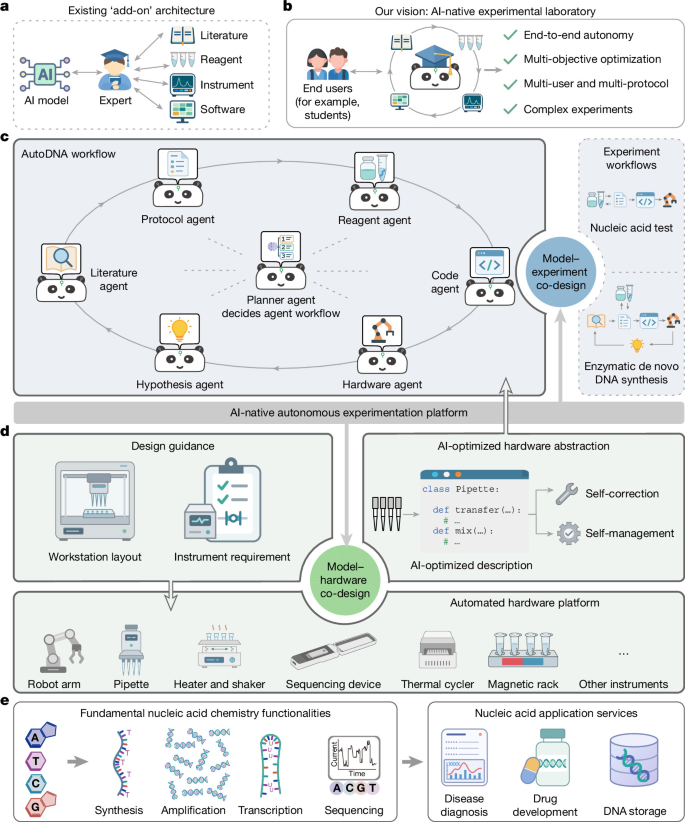
Nature reports on the emergence of an AI-native experimental laboratory designed for autonomous biomolecular operations.
The story
in brief.
What happened, who it affects, and why it landed on our intelligence desk — in plain English, sixty seconds or less.
Nature reports on the emergence of an AI-native experimental laboratory designed for autonomous biomolecular operations. This development signifies a shift towards systems where artificial intelligence independently manages complex biological experiments, reducing human intervention in routine laboratory tasks. The platform integrates advanced machine learning with robotic infrastructure to execute and analyse biomolecular procedures autonomously. This innovation highlights the growing convergence of computational power and life sciences, enabling faster, more precise research outcomes. Professionals in biotechnology and data science should note this trend towards fully automated research environments, which promises to accelerate discovery timelines while fundamentally altering traditional laboratory workflows and operational requirements.
Indicative index of skill mentions in professional job postings for the field this story moves (2019 = 1)
What this means
for your career.
Every headline redistributes opportunity. Here is who this one rewards — and how to be on the right side of it.
This development signals a critical pivot for professionals in life sciences and data technology. Roles requiring manual laboratory execution will diminish, while demand surges for experts who can design, supervise, and interpret autonomous AI systems. You should prioritise acquiring skills in artificial intelligence, data science, and engineering to remain relevant. Professionals in healthcare management and business analysis must also adapt, as operational models shift towards automated research outputs. To future-proof your career, you should immediately upskill in AI strategy and data analytics. Focus on understanding how to integrate AI into biological workflows rather than competing with automation. Engage in continuous learning to bridge the gap between computational methods and biological applications, ensuring you can lead rather than be replaced by these advanced systems.
For this story, the fields that convert it into pay are Artificial Intelligence, Data Science, Engineering and AI in Healthcare — exactly the programmes matched below. The chart shows the indicative salary uplift certified professionals report in each of those fields; every one of them is a click away, from £79, finishing in as few as 20 days.
Indicative ranges from published continuing-education salary studies, by field — each field is a recommended course below
Enrol in these
to benefit.
These programmes position you for exactly this shift — online, self-paced, and finishing with a verifiable certificate you can share the day you pass.
 Best match
Certificate in Artificial Intelligence
 Recommended
Certificate in Data Science
 Recommended
Certificate in Engineering
 Recommended
Certificate in AI in Healthcare
Launch pricing shown against standard certificate value. The fee you see today is the fee you lock in.
This briefing is based on reporting by Nature on 4 Nov, 22:28. Read the original coverage →
Read the news. Then outrun it.
Every LSBR programme is online, self-paced and from £79 — so a headline today can be your credential this month.
