
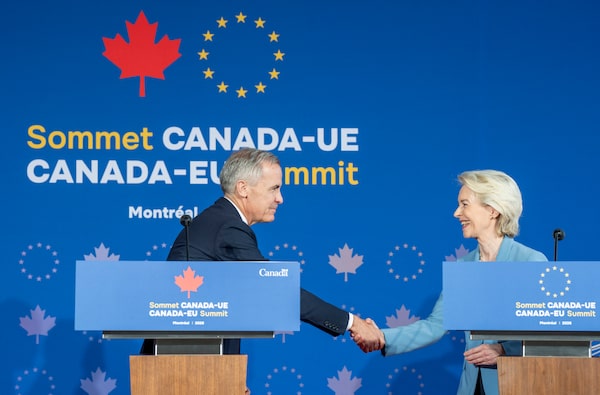
Canada, EU commit to ‘ever-closer association’ to deepen economic, technology and security ties
Canada and the European Union have formally committed to an ‘ever-closer association’, aiming to significantly deepen their economic, technological, and security partnerships.
The story
in brief.
What happened, who it affects, and why it landed on our intelligence desk — in plain English, sixty seconds or less.
Canada and the European Union have formally committed to an ‘ever-closer association’, aiming to significantly deepen their economic, technological, and security partnerships. This strategic move signals a unified front against global geopolitical challenges while fostering tighter regulatory alignment and trade integration between the two blocs. The agreement prioritises collaboration on critical technologies, supply chain resilience, and shared security interests, creating a more cohesive framework for cross-border cooperation. For professionals, this represents a substantial shift in the transatlantic business landscape, emphasising long-term stability and joint innovation initiatives across multiple sectors.
Indicative index of skill mentions in professional job postings for the field this story moves (2019 = 1)
What this means
for your career.
Every headline redistributes opportunity. Here is who this one rewards — and how to be on the right side of it.
This development elevates the value of skills in cross-border regulatory compliance, international trade law, and strategic risk management. You should pay close attention if you operate in sectors reliant on transatlantic supply chains or digital infrastructure. Smart professionals will immediately upskill in understanding EU-Canada regulatory harmonisation, particularly regarding data privacy and technology standards. Prioritise courses in Risk Management and Law to navigate complex international frameworks. Additionally, focus on strengthening your expertise in Supply Chain logistics to anticipate shifts in trade flows. Proactively network with peers in both regions to identify emerging opportunities in joint ventures. Position yourself as a bridge between these markets by mastering the nuances of bilateral policy, ensuring you remain indispensable in an increasingly integrated economic environment.
For this story, the fields that convert it into pay are Risk Management, Law, Supply Chain and Business and Management — exactly the programmes matched below. The chart shows the indicative salary uplift certified professionals report in each of those fields; every one of them is a click away, from £79, finishing in as few as 20 days.
Indicative ranges from published continuing-education salary studies, by field — each field is a recommended course below
Enrol in these
to benefit.
These programmes position you for exactly this shift — online, self-paced, and finishing with a verifiable certificate you can share the day you pass.
 Best match
Certificate in Risk Management
 Recommended
Certificate in Law
Recommended
Certificate in Supply Chain
 Recommended
Certificate in Business and Management
Launch pricing shown against standard certificate value. The fee you see today is the fee you lock in.
This briefing is based on reporting by The Globe and Mail on 30 Oct, 16:50. Read the original coverage →
Read the news. Then outrun it.
Every LSBR programme is online, self-paced and from £79 — so a headline today can be your credential this month.
