
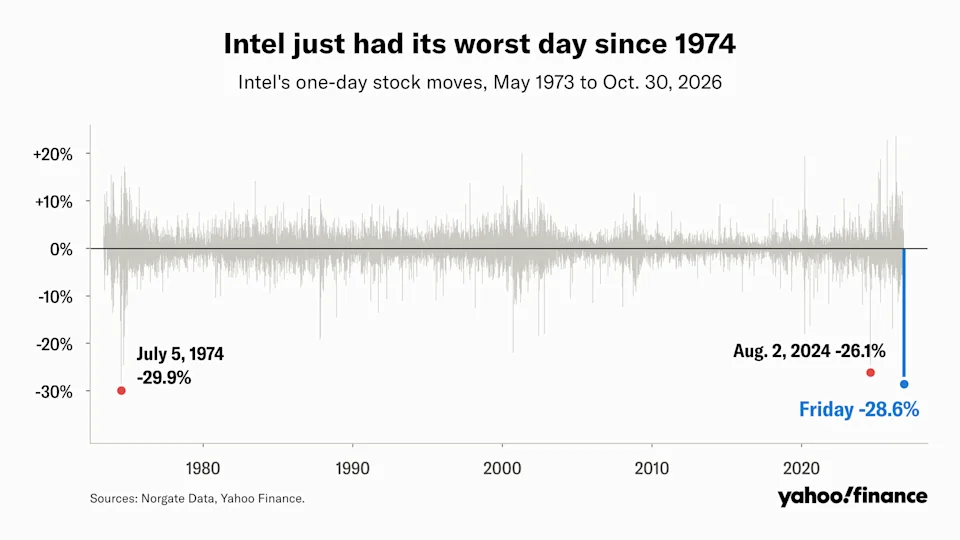
Intel stock plunges nearly 29%, its worst day since 1974
Intel Corporation shares have experienced a dramatic decline, falling by nearly 29% in a single trading session.
The story
in brief.
What happened, who it affects, and why it landed on our intelligence desk — in plain English, sixty seconds or less.
Intel Corporation shares have experienced a dramatic decline, falling by nearly 29% in a single trading session. This represents the company’s most severe daily loss since 1974, marking a significant event in recent market history. The sharp drop reflects intense investor concern regarding the semiconductor giant’s current operational challenges and future outlook. For professionals monitoring the technology sector, this volatility signals substantial uncertainty surrounding one of the industry’s foundational players, potentially affecting broader market sentiment and investment strategies.
Indicative index of skill mentions in professional job postings for the field this story moves (2019 = 1)
What this means
for your career.
Every headline redistributes opportunity. Here is who this one rewards — and how to be on the right side of it.
You must reassess your strategic alignment with legacy semiconductor firms. This volatility underscores the urgent need for expertise in navigating complex market risks and technological transitions. Professionals in finance and engineering should prioritise skills in risk assessment and strategic pivots. You should examine how emerging technologies disrupt traditional hardware monopolies. Focus on developing adaptability and critical analysis capabilities to thrive amid such instability. Consider upskilling in areas that offer resilience against sector-specific shocks. Smart professionals will diversify their knowledge base, ensuring they remain valuable regardless of individual company performance. Monitor industry trends closely, as this event likely triggers broader shifts in tech investment and operational priorities.
For this story, the fields that convert it into pay are Risk Management, Finance, Engineering and Business and Management — exactly the programmes matched below. The chart shows the indicative salary uplift certified professionals report in each of those fields; every one of them is a click away, from £79, finishing in as few as 20 days.
Indicative ranges from published continuing-education salary studies, by field — each field is a recommended course below
Enrol in these
to benefit.
These programmes position you for exactly this shift — online, self-paced, and finishing with a verifiable certificate you can share the day you pass.
 Best match
Certificate in Risk Management
Recommended
Certificate in Finance
 Recommended
Certificate in Engineering
 Recommended
Certificate in Business and Management
Launch pricing shown against standard certificate value. The fee you see today is the fee you lock in.
This briefing is based on reporting by Yahoo Finance on 30 Oct, 20:59. Read the original coverage →
Read the news. Then outrun it.
Every LSBR programme is online, self-paced and from £79 — so a headline today can be your credential this month.
