
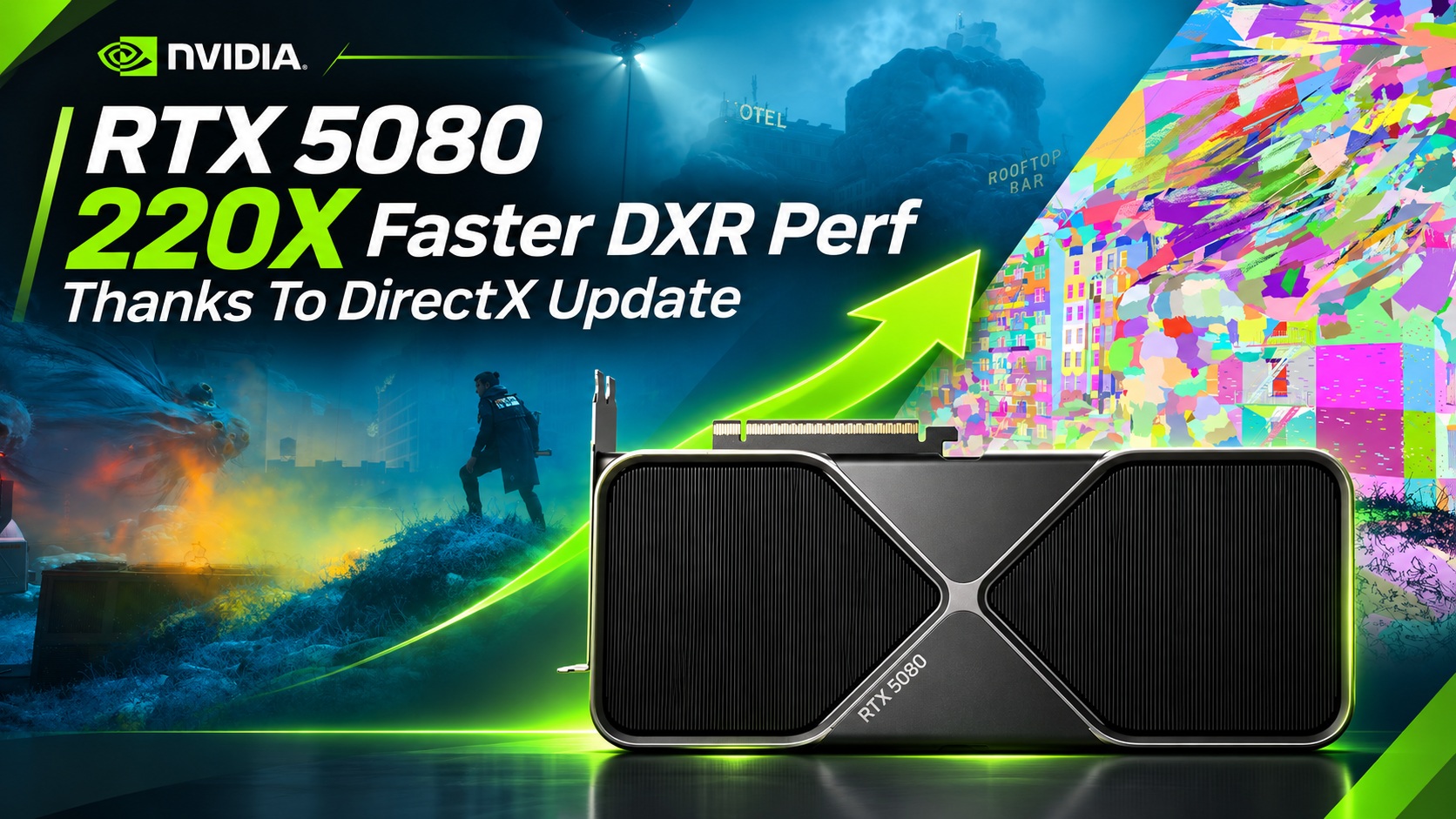
NVIDIA RTX 5080 Sees Over 220X FPS Boost With New DirectX Raytracing Technology, Outpaces RX 9070 XT By 3.4X
Recent reports indicate the NVIDIA RTX 5080 delivers a substantial performance increase in DirectX Raytracing benchmarks, significantly outperforming the competing RX 9070 XT.
The story
in brief.
What happened, who it affects, and why it landed on our intelligence desk — in plain English, sixty seconds or less.
Recent reports indicate the NVIDIA RTX 5080 delivers a substantial performance increase in DirectX Raytracing benchmarks, significantly outperforming the competing RX 9070 XT. This hardware advancement highlights rapid progress in real-time rendering capabilities and GPU efficiency. For professionals, this signals continuing evolution in high-performance computing infrastructure, particularly within graphics-intensive sectors. The data suggests a widening gap in raw processing power for ray-traced workloads, implying that hardware selection remains critical for workflows demanding high-fidelity visual simulation or accelerated compute tasks. Understanding these technical shifts is essential for roles involving digital content creation, simulation, or advanced data visualisation, where processing speed directly impacts productivity and output quality.
Indicative index of skill mentions in professional job postings for the field this story moves (2019 = 1)
What this means
for your career.
Every headline redistributes opportunity. Here is who this one rewards — and how to be on the right side of it.
This hardware leap means your technical stack requires constant vigilance. If you work in graphics, simulation, or high-performance computing, legacy workflows may soon become bottlenecks. You must prioritise skills in GPU-accelerated programming and optimisation, as raw power alone does not guarantee efficiency. Professionals in engineering, gaming, and architectural visualisation should immediately review their rendering pipelines to leverage new ray-tracing features. Do not ignore the underlying architecture; understand how DirectX implementations affect performance. Upskill in CUDA or relevant parallel computing frameworks to remain competitive. Your value lies not just in using the tool, but in extracting maximum efficiency from it. Audit your current hardware dependencies and plan upgrades strategically. Staying ahead of these hardware curves ensures your deliverables meet evolving industry standards without unnecessary latency or cost.
For this story, the fields that convert it into pay are AI in Gaming, Engineering, Cloud computing and AI in Film and Media — exactly the programmes matched below. The chart shows the indicative salary uplift certified professionals report in each of those fields; every one of them is a click away, from £79, finishing in as few as 20 days.
Indicative ranges from published continuing-education salary studies, by field — each field is a recommended course below
Enrol in these
to benefit.
These programmes position you for exactly this shift — online, self-paced, and finishing with a verifiable certificate you can share the day you pass.
 Best match
Certificate in AI in Gaming
 Recommended
Certificate in Engineering
 Recommended
Certificate in Cloud computing
 Recommended
Certificate in AI in Film and Media
Launch pricing shown against standard certificate value. The fee you see today is the fee you lock in.
This briefing is based on reporting by Wccftech on 5 Nov, 12:08. Read the original coverage →
Read the news. Then outrun it.
Every LSBR programme is online, self-paced and from £79 — so a headline today can be your credential this month.
