
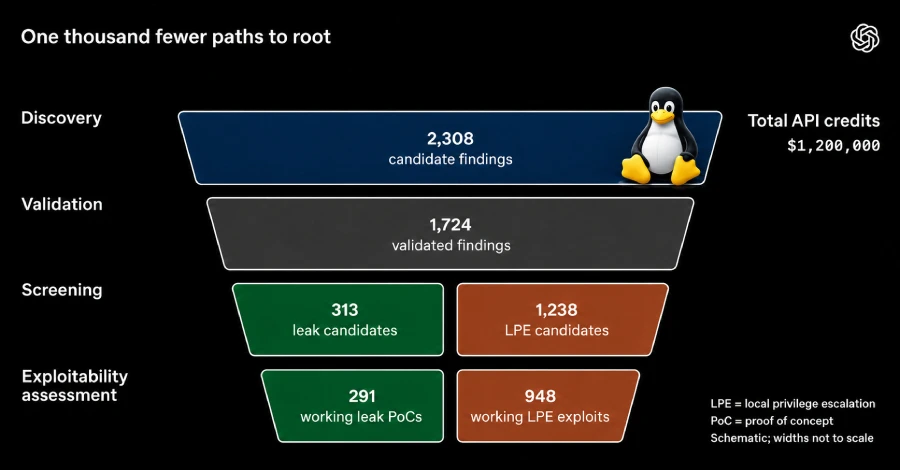
OpenAI AI Pipeline Generates 948 Linux Root Escalation Exploits in 30-Hour Run
Recent reporting indicates that an OpenAI-powered artificial intelligence pipeline successfully generated 948 distinct Linux root escalation exploits during a thirty-hour operational period.
The story
in brief.
What happened, who it affects, and why it landed on our intelligence desk — in plain English, sixty seconds or less.
Recent reporting indicates that an OpenAI-powered artificial intelligence pipeline successfully generated 948 distinct Linux root escalation exploits during a thirty-hour operational period. This automated process demonstrates the capacity of advanced language models to identify and exploit security vulnerabilities within operating systems at scale. The findings highlight a significant shift in how cyber threats can be developed and deployed, moving beyond manual discovery methods. For technology sectors, this underscores the accelerating pace of automated vulnerability research and the potential for AI to lower the barrier to entry for sophisticated cyber attacks, necessitating immediate attention from infrastructure and security teams.
Indicative index of skill mentions in professional job postings for the field this story moves (2019 = 1)
What this means
for your career.
Every headline redistributes opportunity. Here is who this one rewards — and how to be on the right side of it.
This development signals a critical shift in the value of defensive security skills. As AI automates exploit generation, your ability to detect and mitigate automated threats becomes paramount. Professionals in infrastructure and engineering must prioritise learning AI-driven security tools and proactive threat hunting. If you lead technical teams, integrate AI security protocols into your development lifecycle immediately. Non-technical managers should understand these risks to allocate resources effectively for robust defence strategies. Upskill in ethical hacking and secure coding practices to stay ahead of automated attacks. Ignoring this trend leaves your organisation vulnerable to rapid, large-scale breaches. Act now to embed security into your core operations and demonstrate proactive risk management to stakeholders, ensuring your career remains relevant in an increasingly automated threat landscape.
For this story, the fields that convert it into pay are Cyber Security, AI in Cyber Security, Risk Management and Cloud computing — exactly the programmes matched below. The chart shows the indicative salary uplift certified professionals report in each of those fields; every one of them is a click away, from £79, finishing in as few as 20 days.
Indicative ranges from published continuing-education salary studies, by field — each field is a recommended course below
Enrol in these
to benefit.
These programmes position you for exactly this shift — online, self-paced, and finishing with a verifiable certificate you can share the day you pass.
 Best match
Certificate in Cyber Security
 Recommended
Certificate in AI in Cyber Security
 Recommended
Certificate in Risk Management
 Recommended
Certificate in Cloud computing
Launch pricing shown against standard certificate value. The fee you see today is the fee you lock in.
This briefing is based on reporting by The Hacker News on 5 Nov, 04:31. Read the original coverage →
Read the news. Then outrun it.
Every LSBR programme is online, self-paced and from £79 — so a headline today can be your credential this month.
