
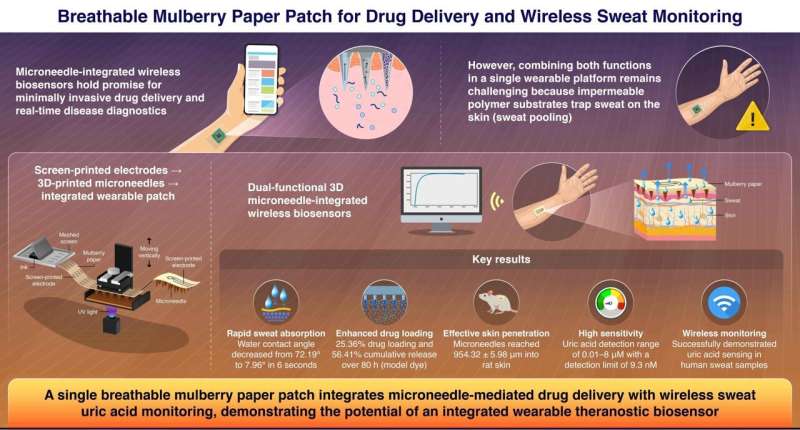
Traditional Korean paper becomes breathable patch for future wearable health care
Researchers have developed a novel wearable health patch using traditional Korean paper, known for its breathability and biocompatibility.
The story
in brief.
What happened, who it affects, and why it landed on our intelligence desk — in plain English, sixty seconds or less.
Researchers have developed a novel wearable health patch using traditional Korean paper, known for its breathability and biocompatibility. This innovation addresses common issues in current wearable technology, such as skin irritation and poor comfort during prolonged use. The study demonstrates that this natural material can effectively monitor physiological signals while maintaining user comfort. This development highlights a shift towards sustainable, bio-compatible materials in medical device engineering. It suggests future healthcare solutions will increasingly integrate traditional craft techniques with modern biotechnology, offering a promising avenue for improved patient adherence and data accuracy in continuous health monitoring applications.
Indicative index of skill mentions in professional job postings for the field this story moves (2019 = 1)
What this means
for your career.
Every headline redistributes opportunity. Here is who this one rewards — and how to be on the right side of it.
This breakthrough signals a growing demand for interdisciplinary expertise in wearable technology and sustainable healthcare solutions. You should pay close attention to the convergence of materials science and medical engineering. Professionals with skills in biomaterials, product design, and regulatory compliance will find their value increasing significantly. To stay ahead, you must understand how traditional manufacturing methods can be scaled for modern medical devices. Engage with cross-functional teams that bridge engineering and clinical needs. Upskill in regulatory affairs for novel medical devices and explore certifications in sustainable product development. By positioning yourself at this intersection, you become indispensable to companies seeking competitive advantages through innovative, patient-centric wearable health technologies.
For this story, the fields that convert it into pay are Healthcare Management, Engineering, Innovation and Project Management — exactly the programmes matched below. The chart shows the indicative salary uplift certified professionals report in each of those fields; every one of them is a click away, from £79, finishing in as few as 20 days.
Indicative ranges from published continuing-education salary studies, by field — each field is a recommended course below
Enrol in these
to benefit.
These programmes position you for exactly this shift — online, self-paced, and finishing with a verifiable certificate you can share the day you pass.
 Best match
Certificate in Healthcare Management
 Recommended
Certificate in Engineering
 Recommended
Certificate in Innovation
 Recommended
Certificate in Project Management
Launch pricing shown against standard certificate value. The fee you see today is the fee you lock in.
This briefing is based on reporting by Phys.org on 4 Nov, 22:00. Read the original coverage →
Read the news. Then outrun it.
Every LSBR programme is online, self-paced and from £79 — so a headline today can be your credential this month.
